
A Dorset Gem Beyond the Coastline
Beyond the familiar coastal splendour of Bournemouth lies a different Dorset, one of rolling green hills and honey-stone market towns steeped in history. At the heart of this inland landscape is Sherborne, a town that presents a unique proposition for any day-tripper: it is home not to one, but to two distinct castles. These structures, separated by a serene lake and centuries of history, stand as silent witnesses to nearly a millennium of English ambition, conflict, and artistry. A visit to “Sherborne Castle” can therefore be a source of confusion. One is a romantic, ruined fortress from the 12th century, managed by English Heritage; the other is a magnificent 16th-century stately home, still a private residence. This guide serves to unravel their intertwined stories, offering a definitive plan for a journey through time, from the era of powerful medieval bishops and swashbuckling Elizabethan adventurers to the landscape genius of the 18th century.

The experience of Sherborne is defined by this duality. The romantic ruins of Sherborne Old Castle stand on one side of a shimmering lake, while the stately grandeur of Sherborne Castle & Gardens, the “New” Castle, gazes back from the other. To understand one is to appreciate the other, for their histories are deeply, and at times violently, connected. This is a place shaped by larger-than-life characters, most notably the courtier Sir Walter Raleigh, whose dream it was to build a home here, and the celebrated landscape architect Lancelot ‘Capability’ Brown, whose vision would ultimately unite the two sites into a single, harmonious masterpiece.
Part I: The Cavalier and the Castle: Sir Walter Raleigh’s Cursed Dream
The story of the newer Sherborne Castle begins with a man who embodied the Elizabethan age: Sir Walter Raleigh. A courtier, poet, soldier, and explorer, Raleigh was a favourite of Queen Elizabeth I. Whilst travelling through Dorset on his way to Plymouth, he became utterly captivated by the Sherborne estate and its ancient medieval castle. Legend tells of a dramatic omen during this first encounter: as Raleigh plotted how he might possess the grounds, his horse stumbled, causing his “very good face” to “plough up the earth where he fell”.
Acquiring a Cursed Estate
Undeterred, Raleigh used his influence at court. In 1592, Queen Elizabeth I was “persuaded” to grant him the estate, which at the time still belonged to the Church, on a 99-year lease. This fateful act of transference from ecclesiastical to secular hands triggered a long-dormant legend. In the 11th century, St. Osmund, a former Bishop of Salisbury, is said to have placed a curse upon the lands, dooming anyone who should take them from the bishopric. This curse would become a recurring motif, framing the dramatic arc of Raleigh’s subsequent misfortunes.

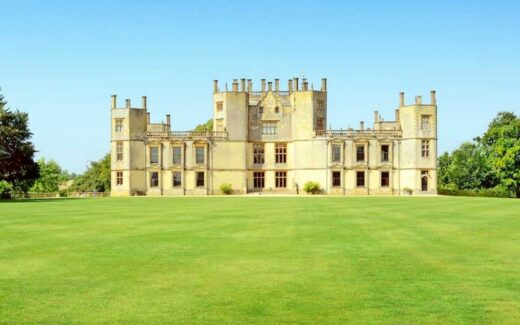
Initially, Raleigh attempted to modernise the old 12th-century castle but found the “large draughty” fortress too costly and impractical for a family home. Instead, he chose a new site within the deer park, converting a former hunting lodge into a sophisticated, four-storey Tudor mansion he named “Fortune’s Fold”. Completed in 1594, it was described by the antiquary John Aubrey as “a delicate Lodge in the park… a place to retire from the Court in summertime, and to contemplate”. The design was innovative, featuring four polygonal corner turrets and a cleverly disguised entrance that preserved the symmetry of the facade.
A Courtier’s Downfall
Just as his dream home was realised, the shadow of St. Osmund’s curse appeared to fall. Raleigh’s secret marriage to Elizabeth ‘Bess’ Throckmorton, one of the Queen’s cherished maids of honour, became public. Enraged by this unsanctioned union, the Queen had both Raleigh and his new wife imprisoned in the Tower of London. Though they were eventually released and returned to Sherborne, Raleigh’s star had begun to wane.
His downfall was sealed with the accession of King James I in 1603. Raleigh fell out of favour, was implicated in a plot against the new king, and was once again imprisoned in the Tower, this time on a charge of high treason. He would remain there for 13 years. In a final, tragic twist that seemed to fulfil the curse, Raleigh had made a will leaving the estate in trust for his son, but a fatal clerical error rendered the deed void. This allowed King James to seize the entire property, which he eventually sold in 1617. Raleigh was executed in 1618, never to see his beloved Sherborne again. His presence, however, endures through folklore. An amusing tale recalls a servant dousing him with a pitcher of beer, mistaking the smoke from his newly introduced tobacco pipe for a fire. More poignantly, his ghost is said to appear near an oak tree on the estate each year around the anniversary of his death, mourning the home he so briefly cherished.
Part II: The Digby Legacy: Forging a Stately Home Through 400 Years
In 1617, the Sherborne estate was purchased by the diplomat Sir John Digby, 1st Earl of Bristol, beginning a new chapter of stability and endurance that contrasts sharply with Raleigh’s fleeting ownership. The Digby family, and their descendants the Wingfield Digby’s, have been the custodians of Sherborne Castle for over 400 years, transforming it from a courtier’s lodge into the grand family seat it is today.

From Lodge to Stately Home
The Digbys immediately set about enlarging Raleigh’s home. In the 1620s, they added four wings to the original rectangular building, creating the current H-shape. In a mark of respect for the original design, they carefully mimicked Raleigh’s architectural style, including the distinctive turrets and square-headed windows, to create a remarkably unified and harmonious whole.
This period of expansion was soon interrupted by the English Civil War, a conflict that would violently intersect the histories of the two castles and forever seal their separate fates. The Digby family were staunch Royalists, and their estate became a key strategic base. The medieval Old Castle was fortified and garrisoned for the King. In August 1645, it was besieged by Parliamentarian forces under the command of Sir Thomas Fairfax. After 11 days of heavy bombardment, the Royalist garrison surrendered. To prevent it from ever being used as a fortress again—a common Parliamentarian tactic—the Old Castle was “slighted,” or deliberately ruined, and left as the romantic shell seen today. The new house, being a home rather than a fortress, was spared. This pivotal moment is the direct cause of the “Tale of Two Castles” that defines the Sherborne landscape.
A Tour Through Time
A visit inside Sherborne Castle is a walk through four centuries of English decorative history. The magnificent staterooms display nationally important collections of art, furniture, and porcelain, gathered by generations of the Digby family. The ceilings feature exquisite Jacobean plasterwork, a testament to the early expansions. Yet, echoes of the founder remain. In the cellars, visitors can discover Raleigh’s original kitchen, a tangible link to the castle’s origins. A Family Museum further connects the two sites, displaying family curios alongside archaeological finds unearthed from the ruins of the Old Castle. This is not a static museum but a living home, whose more recent history includes serving as a Red Cross hospital during the First World War and as a headquarters for commandos involved in the D-Day landings in the Second World War.

Part III: An English Eden: Exploring the ‘Capability’ Brown Gardens
The grounds of Sherborne Castle are not merely a backdrop for the house; they are a masterpiece of art and engineering in their own right. This is the work of Lancelot ‘Capability’ Brown, widely regarded as Britain’s greatest landscape gardener. Commissioned from 1753, Sherborne was one of his first major projects and remains a largely unaltered example of his genius.
The Grand Vision
Brown’s revolutionary approach involved sweeping away the rigid, formal geometric gardens of the 17th century. In their place, he created romantic, naturalistic parklands of rolling lawns, sweeping vistas, serpentine water features, and artfully placed clumps of trees. The spectacular centrepiece of his design at Sherborne is the 50-acre lake, which he created by ingeniously damming the River Yeo.
Brown’s work provides the ultimate unifying chapter in the “Tale of Two Castles.” The Civil War had physically and symbolically separated the two structures. For a century, one was a thriving home while the other was a decaying relic. Brown, seeing the landscape as a single canvas, artistically reconnected them. His most celebrated stroke of genius was to incorporate the now-ruined Old Castle into his design. Viewed across the serene expanse of his new lake, the ruins were transformed into a deliberately framed “eyecatcher”—a romantic, picturesque focal point that adds a sense of history and melancholy beauty to the landscape. The ruin was no longer just a scar of a violent past; it became an essential component of a beautiful, peaceful present, turning a history of division into a landscape of harmony.

A Walk Through the Grounds
The 42 acres of gardens and pleasure grounds offer a series of delightful walks, with two main routes suggested on the visitor map.
- The Pleasure Grounds and Fossil House Walk: This longer route of approximately 2.1 km takes visitors through the heart of the gardens.
- The Thatched Hut and Gingko Lawn Walk: A shorter 1.6 km walk, this route showcases some of the estate’s champion trees, including historic Cedars of Lebanon and a particularly important Ginkgo tree.
Along the way, walkers can discover key features such as the spectacular Cascade, the elegant Orangery (thought to have been designed by Brown’s son-in-law, Henry Holland), and Pope’s Seat. This stone alcove is named for the poet Alexander Pope, a family friend who advised the Digbys on laying out the grounds even before Brown’s arrival. The garden is a place for all seasons, from the “swathes of daffodils” in spring to the vibrant herbaceous borders of summer and the “breathtaking colours of Autumn reflected in the lake”.
Part IV: The Practical Guide: Planning a Visit from Bournemouth
This section provides all the necessary information for a seamless and enjoyable day trip from the coast to the heart of Dorset.

| At-a-Glance Travel Planner: Bournemouth to Sherborne | |||
| Mode | Average Journey Time | Estimated Cost | Best For |
| Car | Approx. 1 hour 5 minutes | Fuel + Parking | Speed, flexibility, and visiting other nearby sites. |
| Train | Approx. 2 hours 30 minutes | £30 – £70 (Return) | A relaxing, car-free day out with a scenic walk to the castle. |
Getting There in Detail
- By Car: The drive from Bournemouth is approximately 39 miles and typically takes just over an hour. The most direct route is often via the A31, A350, and A30. For Sherborne Castle & Gardens, the single visitor entrance is on New Road (B3145), with ample on-site parking. For Sherborne Old Castle, there is separate, limited parking, where a £3 donation is requested, payable by text.
- By Train: This is the best public transport option. Services run from Bournemouth to Sherborne station, though the journey usually requires two changes, typically at Southampton Central and Salisbury. Operators include South Western Railway. Booking tickets in advance can offer significant savings. From Sherborne station, the entrance to the Castle & Gardens is a pleasant and well-signposted 10 to 15-minute walk.
- By Bus: While possible, bus travel from Bournemouth is not recommended due to multiple changes and significantly longer journey times.

The Two Sites: Know Before You Go
It is essential to understand that the two castles are separate attractions with different management, opening times, and admission policies.
Sherborne Castle & Gardens (The Mansion)
- Ownership: Privately owned by the Wingfield Digby family.
- Opening Times: The gardens are generally open daily from April to November. The Castle itself has more limited opening hours, typically from May to September. It is crucial to check the official website for the most up-to-date times before travelling.
- Tickets: Admission is charged for the Castle & Gardens (Adult ticket approx. £19.50). Members of Historic Houses receive free entry.

Sherborne Old Castle (The Ruins)
- Ownership: Managed by English Heritage.
- Opening Times: The ruins are typically open daily throughout the year, with shorter hours in the winter months (10am-5pm in summer, 10am-4pm in winter).
- Tickets: Entry to the ruins is FREE for all visitors.

Visitor Essentials
Facilities are primarily located at Sherborne Castle & Gardens.
- Food & Drink: The Walled Garden Restaurant offers meals and refreshments; visitors can ask for a 5% discount voucher upon arrival. Picnics are also welcome in the beautiful grounds.
- Facilities: The site includes public toilets, a gift shop, and good accessibility, with ramps and accessible loos available.
- Important Rules: Photography and the use of mobile phones are not permitted inside the Castle. Dogs are very welcome in the gardens and grounds provided they are kept on a short lead, but they are not allowed inside the Castle (with the exception of assistance dogs).

The Enduring Allure of Sherborne
A day trip to Sherborne is a journey through the very heart of English history. It is a story of ambition and tragedy, of endurance and adaptation, and of artistic vision that can transform a landscape of conflict into one of perfect harmony. The unique “Tale of Two Castles” offers a rich and layered experience, from the cursed dreams of an Elizabethan adventurer to the enduring legacy of a 400-year-old family dynasty, all unified by the timeless genius of Capability Brown. To complete the experience, visitors should also set aside time to explore the charming market town of Sherborne itself, with its magnificent Abbey and independent shops, making a day trip from Bournemouth a truly unforgettable escape.
Leave a Reply
You must be logged in to post a comment.