
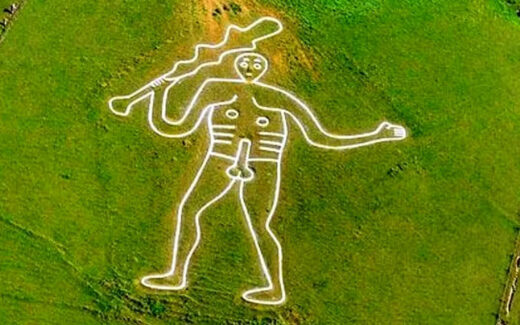
There is a moment on the winding roads that weave through the chalk downlands of Dorset when the quintessential English countryside performs a startling act of revelation. One minute, you are immersed in a pastoral dreamscape of rolling green hills, ancient woodlands, and quiet valleys steeped in the lore of Thomas Hardy’s Wessex. The next, you are confronted by him. Etched into the turf in stark white lines is a figure so primal, so unabashedly pagan, that he seems to have burst forth from a forgotten age. This is the Cerne Abbas Giant, Britain’s largest and most notoriously virile chalk figure, a silent sentinel who has perplexed and provoked for centuries.
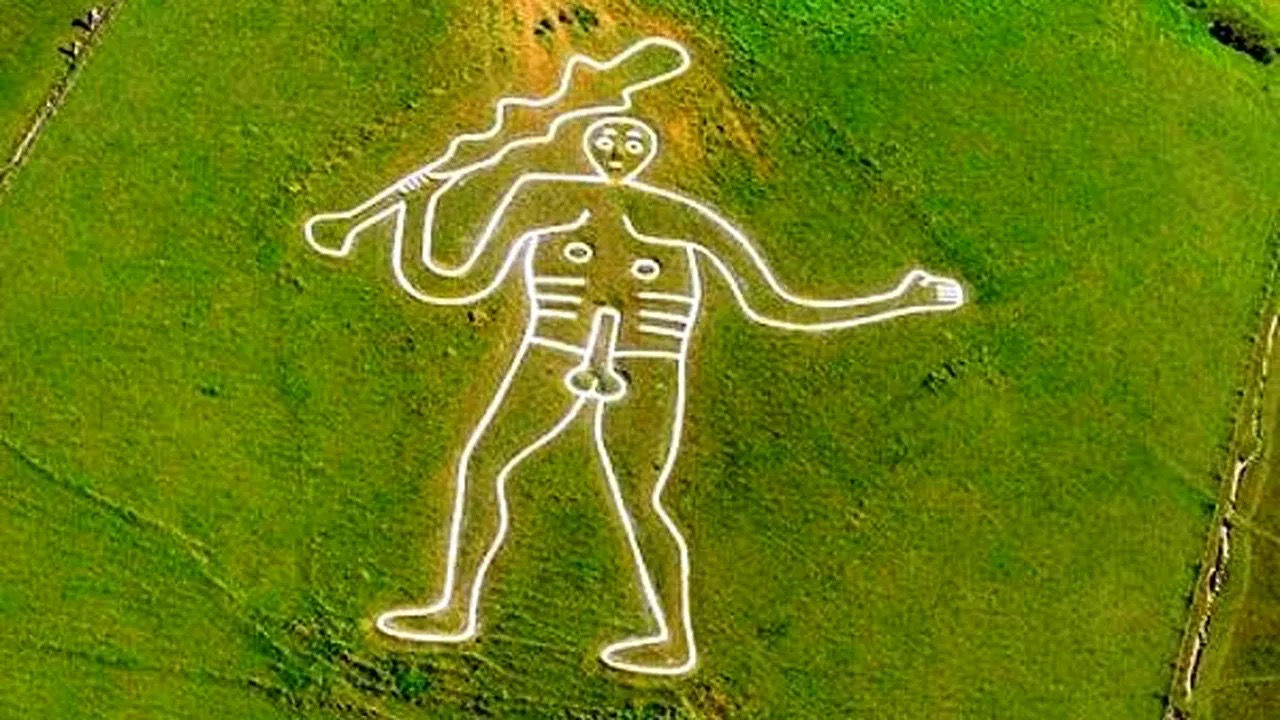
Standing an imposing 180 feet (55 metres) tall, the Giant strides across the hillside brandishing a gnarled, 120-foot club. But it is his other prominent feature—a formidable, 36-foot erect phallus—that has earned him his affectionate local nickname, ‘The Rude Man of Cerne’, and cemented his reputation as a figure of awesome, untamed potency. His sheer scale and explicit nature are breathtaking, a shocking anomaly in a landscape otherwise defined by the gentle piety of village churches and ruined abbeys. In the valley below, the village of Cerne Abbas grew around a great Benedictine Abbey founded in AD 987, its history interwoven with the rhythms of Christian worship. Yet, looming above it all is this blatantly pagan symbol, a testament to a wilder, pre-Christian worldview that has somehow endured in plain sight. This juxtaposition creates a profound tension. Was the abbey deliberately sited to tame the Giant’s power, or does he represent a defiant flicker of an older faith that refused to be extinguished? For generations, he has posed the same silent questions to all who gaze upon him: Who are you? Who carved you into this hill, and why? The quest to answer these questions is a detective story that winds through centuries of folklore, political satire, and, most recently, groundbreaking science.
The Great Detective Story: Unmasking the Giant
For much of its known history, the story of the Cerne Abbas Giant has been a tapestry of educated guesswork and colourful speculation. The lack of any definitive written record before the late 17th century created a vacuum that historians and antiquarians eagerly filled with compelling, if contradictory, theories.
The Early Theories: A Political Satire or an Ancient God?
For a long time, the most widely accepted theory placed the Giant’s creation in the turbulent 17th century. The first known written reference to him is a modest entry in the churchwarden’s accounts from St Mary’s Church in Cerne Abbas, dated 4 November 1694, noting a payment of three shillings “for repairing ye Giant”. The absence of any mention in earlier, detailed surveys of Dorset led many to conclude he was a relatively modern creation. The prevailing narrative was that the figure was a satirical caricature of Oliver Cromwell, engineered by the local landowner, Lord Denzil Holles, a fierce opponent of the Lord Protector. Cromwell’s enemies had mockingly dubbed him “England’s Hercules,” and this theory posits that the Giant’s club represented his brutal military rule, while the prominent phallus was a crude jab at his Puritanism.
An alternative school of thought looked much further back in time, seeing in the Giant’s form a link to the classical world. Archaeologists, notably Stuart Piggott in the 1930s, argued that the figure was a Romano-British depiction of the demigod Hercules. Hercules was often shown nude and brandishing a club. This theory was bolstered by a 1996 study which found evidence that the Giant originally had a cloak or animal skin draped over his outstretched left arm—a classic Herculean motif representing the skin of the Nemean lion. Others pushed the timeline back even further, suggesting he was a prehistoric Celtic deity, perhaps the god Nodens, or a primeval fertility symbol worshipped in ancient rituals long before the Romans arrived.

The Scientific Revelation: A Game-Changer in the Chalk
For centuries, these theories were debated without resolution. Then, in 2019, the National Trust, which has cared for the site since 1920, embarked on a project that would change everything. Archaeologists took soil samples from the deepest layers of the Giant’s chalk outline—from his elbows and feet—for analysis using a technique called Optically Stimulated Luminescence (OSL). In simple terms, OSL can determine when grains of sand were last exposed to sunlight. By measuring the light emitted from these grains when stimulated by a laser, scientists can calculate the date they were buried—in this case, when the trenches were first dug and filled with chalk.
The results, announced in 2021, were, in the words of National Trust archaeologist Martin Papworth, “flabbergasting”. The science was unequivocal: the Giant was not prehistoric, nor was he a 17th-century satire. The deepest samples dated his creation to the late Saxon period, sometime between
AD 700 and 1100. This stunning revelation completely rewrote the Giant’s history, placing him squarely in the era of Viking raids and the founding of the nearby Cerne Abbey in AD 987.
The Mystery of the “Lost Centuries”
This new, scientifically robust date created a profound paradox. If the Giant was carved into the hillside during the Saxon era, a time of growing literacy and record-keeping, why is there a complete and utter silence about him in the historical record for nearly a thousand years? He is absent from the Domesday Book of 1086, which meticulously catalogued the area. More bafflingly, there is no mention of him in the extensive surviving records of Cerne Abbey, whose monks would have seen him from their windows every day. The paper trail only begins with that humble repair bill in 1694.
To solve this riddle, Martin Papworth proposed an elegant theory: the mystery of the “lost centuries.” He suggests the Giant was indeed created in the Saxon period, but for reasons unknown, was subsequently neglected. Over hundreds of years, the chalk lines would have slowly vanished, grassed over and forgotten, becoming a mere ghost on the hillside. Then, perhaps in the 17th century, the figure was rediscovered—its faint outline possibly visible only in the low light of dawn or dusk—and re-cut by the locals. This hypothesis brilliantly reconciles the ancient scientific date with the modern historical record, suggesting a story not of continuous existence, but of loss and rediscovery.
The Latest Chapter: A Saxon Army’s Battle Standard?
The Saxon dating opened up a new field of inquiry, and in 2024, academics Helen Gittos and Tom Morcom from the University of Oxford published a compelling new theory that synthesises all the available evidence. They argue that the Giant is indeed a representation of Hercules, but a specifically Anglo-Saxon interpretation. Far from being an obscure figure, Hercules was well-known in the 9th and 10th centuries as a potent symbol of strength, courage, and masculinity—an ideal figure to inspire warriors.
Their groundbreaking hypothesis is that the Cerne Giant was created as a monumental landmark, a muster station for West Saxon armies to gather before marching to fight off the Viking forces that were raiding the Dorset coast. The location was strategically perfect. It was situated on an estate owned by the West Saxon royal family, protruded from a ridge near major routeways, and had access to fresh water and farmland to supply converging troops. What better way to coordinate a military gathering than a memo simply saying, “Meet us by the big naked giant”?
This theory also provides a fascinating final twist to the tale. The monks of Cerne Abbey, established at the foot of Giant Hill, would have been deeply uncomfortable with a colossal, naked pagan warrior looming over their monastery. To neutralise this inconvenient pagan symbol on their doorstep, the monks engaged in a clever piece of intellectual rebranding. Gittos and Morcom found evidence in an 11th-century manuscript that the monks reinterpreted the figure as their local patron saint, Eadwold, a hermit who was said to have lived on the hill. By associating the Giant with a Christian saint, they effectively absorbed him into their own worldview, stripping him of his pagan power and claiming him for the church.
This long and complex history reveals that the Giant is not a static relic from a single point in time. He is a dynamic cultural canvas, a palimpsest upon which successive generations have inscribed their own meanings. He began as a martial symbol for Saxon warriors, was recast as a Christian saint by medieval monks, and was later re-imagined as a political satire against a Puritan leader. Even his physical form has likely evolved. Some research suggests his now-famous phallus was a later addition or an enhancement, possibly created during a 1908 re-cut when a circle representing his navel was merged with a previously smaller penis. In the modern era, he has been co-opted for everything from condom advertisements to a publicity stunt for
The Simpsons Movie. The Giant we see today is a layered artifact, bearing the marks of a thousand years of English history, belief, and humour.
Whispers on the Hillside: Folklore, Fertility, and Festivities
While academics debate his origins, the Giant has lived a rich and vibrant life in the realm of folklore and local tradition. For centuries, long before scientific dating, people have imbued him with a power that transcends historical fact.
His most enduring reputation is as a potent symbol of fertility. For generations, local folklore has held that a woman who sleeps on the hillside within his outline will be blessed with fecundity, and that sexual intercourse upon his phallus is a powerful cure for infertility. This belief is not merely a historical curiosity. In the 20th century, the eccentric 6th Marquess of Bath and his wife, having struggled to conceive, reportedly paid a visit. Ten months later, their daughter was born, whom they named Silvy Cerne in the Giant’s honour. This potent connection to life and creation is perhaps his most powerful legacy.
Other legends speak of a more violent origin. One popular tale recounts how a real giant from Denmark terrorised the countryside, feasting on local livestock. After gorging himself, he fell asleep on the hillside, where the brave villagers crept up, decapitated him, and then carved his outline into the chalk as a permanent warning to other marauders.
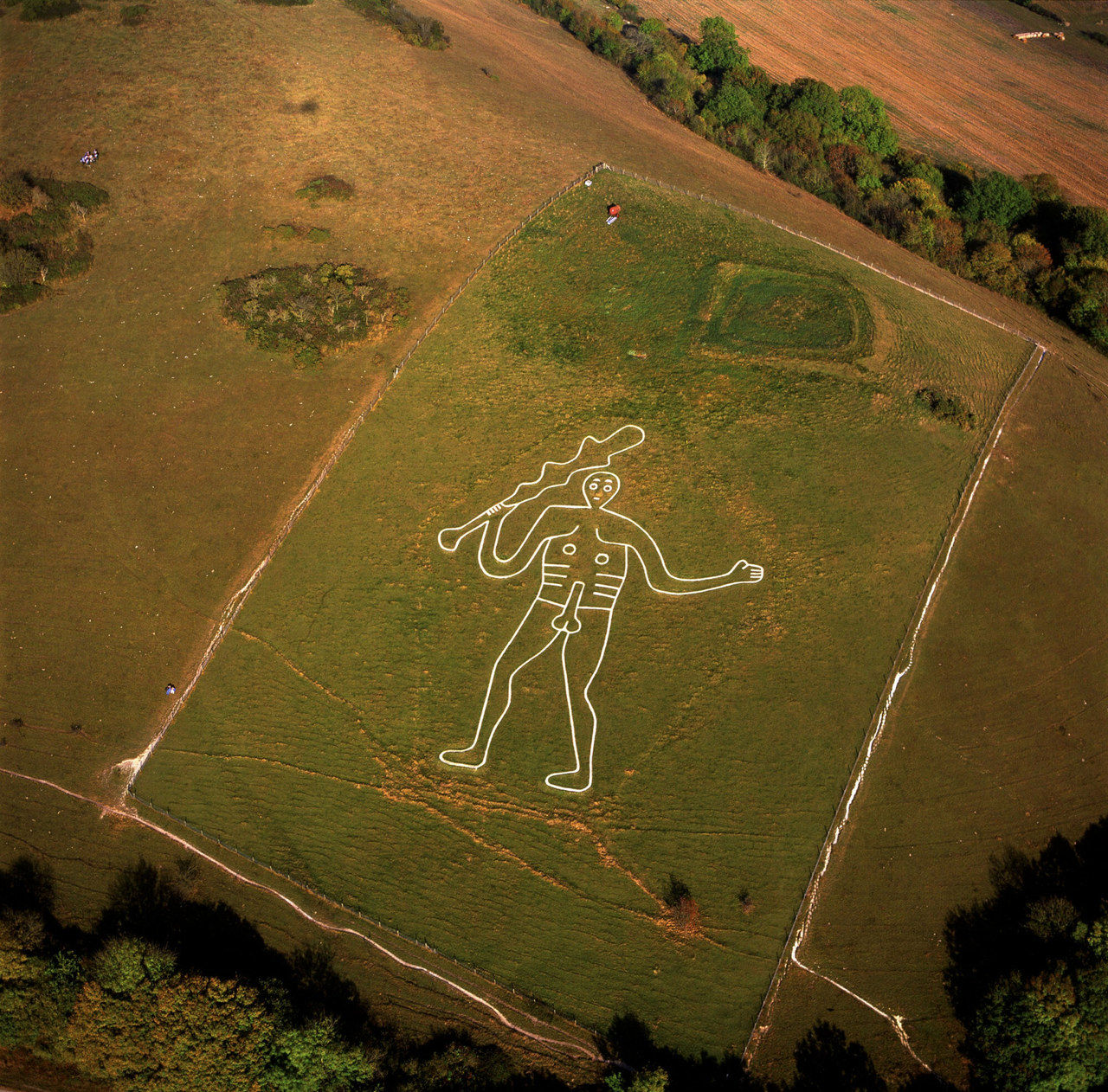
Today, the Giant remains a living part of the community’s cultural life. Above his head lies a rectangular Iron Age earthwork known as the ‘Trendle’ or ‘Frying Pan’. Every year on May Day, as the sun rises, the Wessex Morris Men gather here to dance and welcome the summer, a tradition that connects the Giant to ancient rites of seasonal celebration and the renewal of the land. This sacred landscape is further enriched by the presence of St Augustine’s Well, also known as the Silver Well, located near the abbey ruins. The waters of this ancient spring were also believed to aid fertility, particularly in women. Together, the masculine energy of the Giant on the hill and the feminine, life-giving waters of the well below create a powerful spiritual nexus that has drawn pilgrims for centuries.
Planning Your Pilgrimage: A Practical Guide from Bournemouth
A visit to the Cerne Abbas Giant is an essential Dorset experience. Lying just north of Dorchester, the village and its famous resident are easily accessible for a memorable day trip from Bournemouth.
Getting to Cerne Abbas
By Car: This is the simplest and most flexible way to travel. The journey of approximately 31 miles takes around 45 to 55 minutes, depending on traffic. The most direct route is to take the A338 and A35 west towards Dorchester, then follow the A352 north. The drive itself is a pleasure, taking you through some of Dorset’s most beautiful and unspoilt countryside.
By Public Transport: Reaching Cerne Abbas without a car is possible but requires more planning. The fastest option is to take a South Western Railway train from Bournemouth to Dorchester South or Upwey (around 50 minutes), and then take a taxi for the remaining 8 miles, a journey of about 15-20 minutes. This is also the most expensive option. A cheaper, but significantly slower, alternative involves taking a bus (e.g., National Express) from Bournemouth to Dorchester, and then catching the limited local bus service (e.g., Damory Coaches 216 or South West Coaches service 5) to Cerne Abbas. This can take up to 2.5 hours and services, particularly to the village, can be infrequent and may not run on weekends.
| Travel Mode | Estimated Time (One Way) | Estimated Cost (Round Trip) | Key Considerations |
| Car | 45-55 minutes | £8-£15 (petrol) | The most direct, convenient, and flexible option, allowing you to explore the wider area. |
| Train & Taxi | ~1 hour 10 minutes | £45-£80+ | A fast and comfortable journey to Dorchester, but the final taxi leg adds significant cost. |
| Bus | ~2 hours 30 minutes | £10-£15 | The most budget-friendly option, but it is slow, requires transfers, and bus services to the village are limited. |
On Arrival: Parking and Viewing the Giant
Crucially, the best view of the Giant is not from up close. To appreciate his full form and scale, you need to see him from a distance, across the valley.
Giant’s View Car Park: For that perfect, postcard photograph, head to the dedicated viewing area. This is a small, free lay-by car park located directly on the A352, just north of the village turn-off. From here, the view is direct and unobstructed. For satellite navigation, the postcode DT2 7AL will get you there.
Kettle Bridge Village Car Park: If you plan to explore the village or walk up Giant’s Hill, the best place to park is the larger village car park next to the Village Hall on Kettle Bridge Lane. Parking is free, but a £1 donation is suggested to help with upkeep. From here, it’s a pleasant five-minute walk into the village centre. The postcode is DT2 7GY.
Walking to the Giant’s Feet: From the village, a signposted footpath leads you on a short walk to the base of Giant’s Hill. While it is thrilling to stand in his shadow and appreciate his immense size up close, be aware that the figure is almost impossible to discern from this angle due to the steepness of the hill. The panoramic views of the Cerne Valley from the top of the hill, however, are well worth the climb.
A Note on Conservation
The Cerne Giant is a protected Scheduled Ancient Monument, and his care is entrusted to the National Trust. To prevent erosion and damage from footfall, the figure itself is fenced off and public access is strictly prohibited. The Giant’s pristine white outline is maintained through a painstaking process of re-chalking, undertaken by a team of National Trust rangers and dedicated volunteers. This labour-intensive task, which involves digging out the old lines and packing in fresh chalk by hand, happens roughly once a decade to ensure the Rude Man remains a striking feature of the Dorset landscape for generations to come.
Beyond the Giant: A Day in Cerne Abbas Village
While the Giant may be the main draw, the village of Cerne Abbas is a destination in its own right, a perfectly preserved slice of English history that rewards a full day of exploration.
A Village Steeped in History
Walking through Cerne Abbas feels like stepping back in time. The main streets are lined with charming timber-framed and stone cottages, many dating back centuries. The village owes its existence to the Benedictine Abbey founded in AD 987, but its prosperity was secured long after the Abbey’s destruction during the Dissolution of the Monasteries. The pure, chalk-filtered spring water of the River Cerne proved perfect for brewing, and for a time, Cerne Abbas was a major brewing centre, its ales exported as far as London and even the Americas.
Exploring the Abbey Ruins and St Mary’s Church
The remains of the great Abbey are a must-see. Now on private land behind a grand house on Abbey Street, the grounds containing the surviving Abbot’s Porch and Guesthouse are often open to the public for a small donation via an honesty box. The Abbot’s Porch is a magnificent three-storey gatehouse with stunning 15th-century oriel windows. A short walk away is the tranquil
St Augustine’s Well, shaded by trees in the corner of the graveyard.
The village’s parish church, St Mary’s, is a beautiful building largely dating from the 14th and 15th centuries. Its light, airy interior contains a wealth of historic treasures, including medieval wall paintings, elegant painted biblical texts from 1679, and an ancient font. The church also houses excellent information displays on the history of both the village and the Abbey.
Local Flavours: Pubs, Tea Rooms, and a Brewery
For a village of its size, Cerne Abbas is exceptionally well-served with places to eat and drink. There are three historic pubs, each with its own unique character. The New Inn is a handsome 16th-century former coaching inn, The Giant Inn offers a warm welcome, and The Royal Oak is full of historic charm. All serve excellent food and a range of local ales. For a lighter bite or a traditional Dorset cream tea,
Abbots Tea Room is a delightful choice.
Beer enthusiasts should not miss a visit to the award-winning Cerne Abbas Brewery. Using local organic barley and the same pure water that fuelled the village’s brewing heyday, they produce a fantastic range of ales. The brewery has a taproom and a beer garden, open on Fridays and Saturdays, where you can sample their creations at their freshest.
Walking the Cerne Valley
For those with the time and energy, Cerne Abbas is a superb base for walking. The village sits on the Cerne Valley Way, a circular trail that follows the course of the river. Numerous other footpaths lead out from the village into the surrounding hills of the Dorset Area of Outstanding Natural Beauty, offering breathtaking views and a chance to immerse yourself in this ancient landscape.
The Enduring Enigma
A trip to Cerne Abbas is a journey into the heart of a profound mystery. Modern science may have finally answered the long-standing question of when the Giant was carved, placing him firmly in the world of the Anglo-Saxons. Yet the ultimate question, the one that truly matters, remains tantalisingly unanswered: why? Was he a pagan god of fertility, a symbol of defiance against a new religion? Or was he a martial beacon, a Herculean figure designed to rally armies and strike fear into the hearts of Viking invaders?
Perhaps his true power lies in this very ambiguity. He refuses to be neatly categorised or definitively explained. He is not a static museum piece but a living, breathing part of the landscape that continues to fuel folklore, inspire celebration, and provoke our deepest sense of wonder. The Rude Man on the hill keeps his secrets, and it is this enduring enigma that makes a pilgrimage to stand in his formidable presence an utterly unforgettable experience.
Leave a Reply
You must be logged in to post a comment.