

The Bovington Reserve – A Sanctuary for Steel Behemoths
Deep within the rolling green hills of Dorset, a landscape more commonly associated with quiet villages and ancient coastlines, lies a unique and astonishing wildlife reserve. This is no sanctuary for flesh and blood, but a carefully managed habitat for a herd of mechanical megafauna. Here, nearly 300 steel beasts from 26 countries graze silently in their purpose-built halls—a global collection of armoured fighting vehicles that represents the most complete lineage of this remarkable species anywhere on Earth.
A visit to this place is best understood not as a trip to a museum, but as a safari or field expedition into the home of the tank. It is an opportunity to observe these magnificent, and often dangerous, creatures up close, to understand their evolution, their behaviours, and their profound impact on the human world. The institution’s own tagline, “the biggest day out in history,” might be more accurately re-contextualised as the biggest safari in history, a journey into a world of iron and oil. The wardens of this unique sanctuary have created a space for both study and awe. The very idea for such a reserve was first proposed in 1923 by the writer Rudyard Kipling, who, upon seeing the battle-scarred veterans of the First World War, recommended a place be set aside for their preservation. His vision was formally realised in 1947, establishing a permanent home where these iron giants could be protected and understood by future generations.

Genesis – The First of the Landships
The Primordial Environment
To understand the emergence of this new mechanical lifeform, one must first journey back to its primordial environment. The museum’s immersive “Trench Experience” exhibition serves as a time machine, transporting the observer to the hostile conditions of the First World War. This recreation of a Western Front trench system, complete with the sounds of battle and period-costumed mannequins, illustrates the immense evolutionary pressure that demanded a new kind of creature. The static, mud-choked landscape of trench warfare had rendered traditional cavalry obsolete and created a deadly stalemate that only a revolutionary adaptation could break.
The Common Ancestor: ‘Little Willie’
From these extreme conditions emerged the common ancestor of all tanks: ‘Little Willie’. Constructed in 1915, this is the world’s first working tank prototype and the crucial “missing link” in armoured evolution. In biological terms, it was a primitive creature, a 16-ton behemoth with a rudimentary track system capable of a ponderous 3.5 mph. Its creation by William Foster & Co., an agricultural machinery firm, represents an unexpected evolutionary leap, repurposing the technology of the farm for the battlefield. While ‘Little Willie’ never saw combat, its successful trials proved that a vehicle combining an internal combustion engine, armoured protection, and caterpillar tracks was viable. Yet, such was the brutal pace of wartime innovation that even as it was being completed, its designers had conceived of a superior form, rendering this progenitor almost obsolete at birth.
First of the Breed: The Mark I
The direct descendant of ‘Little Willie’s’ concept was the Mark I, the world’s oldest surviving combat tank and the first of its kind to see battle. Its distinctive rhomboidal shape was a specific anatomical adaptation, engineered to span the wide chasms of the trenches and crawl over obstacles that would halt any other vehicle. This creature was not a solitary hunter; its existence depended on a symbiotic, and often fatal, relationship with the humans inside it. The “Tank Men” exhibition explores this crucial symbiosis, telling the story of the first crews who lived, fought, and frequently died within these claustrophobic steel shells, guiding their monstrous charges across the battlefield.
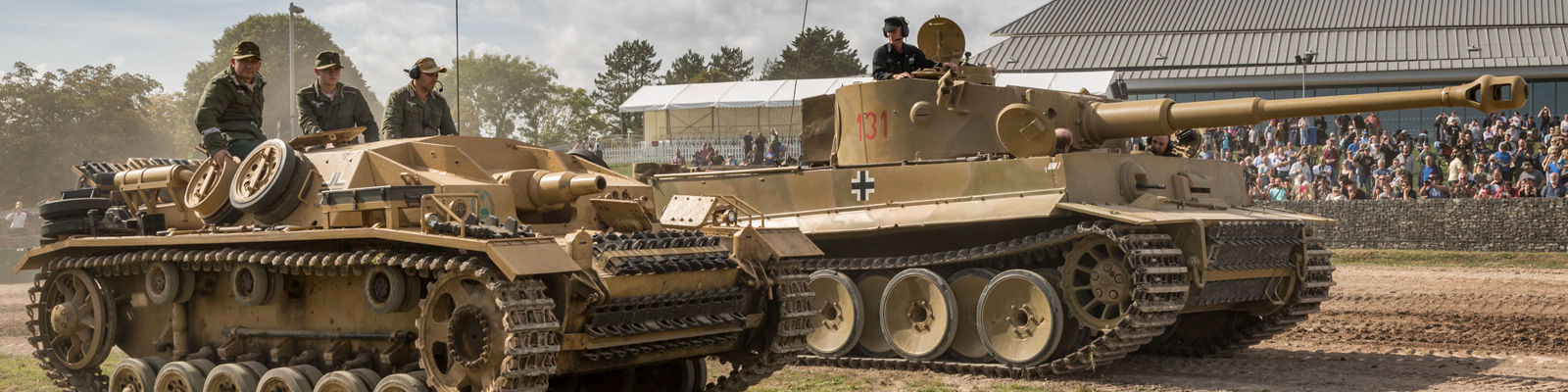
An Evolutionary Explosion – A Survey of the 20th-Century Breeds
The sheer diversity of the collection at Bovington is a physical record of a technological arms race. The chronological arrangement of the exhibitions, from “The Tank Story Hall” to “WW2: War Stories,” allows the observer to witness a tangible story of mechanical evolution. Each design is a direct response to the capabilities of its rivals and the demands of new environments, illustrating the principles of iterative design and adaptation under the most extreme pressures. The presence of multiple variants of the same “species,” such as the American Sherman or the British Centurion, is akin to observing subspecies that have adapted to different combat niches. A walk through these halls is a journey through a living laboratory of 20th-century warfare.
The Interwar Period & The Thick-Skinned Herbivores
The “War Horse to Horsepower” exhibition documents the critical transition from cavalry to mechanisation, a period of intense experimentation. During this time, British doctrine favoured the development of slow but heavily armoured “Infantry Tanks,” creatures analogous to a rhinoceros—formidable in defence but not built for speed. Prime examples of this breed are the Matilda II and the Churchill III. The Matilda II, in particular, proved to be a species perfectly suited to its initial environment, its thick hide making it almost impervious to early anti-tank weaponry and allowing it to dominate the battlefields of the Western Desert until 1941.
The Pack Hunters of the Second World War
The Second World War saw the rise of the medium tank, a more balanced and versatile breed that came to define the conflict. The most prolific of these was the American M4 Sherman, a species so adaptable it could be compared to a wolf, thriving in packs on every front from North Africa to North-West Europe. The museum is home to several variants, including the M4A2 Sherman that starred in the 2014 film
Fury. These American predators competed in a complex ecosystem alongside other successful breeds, including the agile German Panzers (of which the museum has examples of the II, III, and IV) and the revolutionary Soviet T-34, each with its own distinct hunting characteristics.
The Apex Predator – A Study of Tiger 131
Towering over all other predators of its era was the German Tiger I. With its fearsome reputation, powerful 88mm gun, and armour that was virtually impenetrable to most Allied weapons, it was the undisputed apex predator of the Second World War battlefield. The reserve at Bovington is home to the most famous individual of this species: Tiger 131. Its story is one of high drama. Captured largely intact by the 48th Royal Tank Regiment in Tunisia on 24 April 1943, its battle scars—gouges on the gun mantlet and turret—are still visible today. So significant was its capture that both Prime Minister Winston Churchill and King George VI travelled to North Africa to inspect it before it was shipped to Britain for analysis.
Today, Tiger 131 is more than just an exhibit; it is the charismatic megafauna around which the museum’s entire operational philosophy revolves. As the world’s only running Tiger I, its rarity is its greatest asset. The museum’s wardens have built a successful conservation model around its fame, running it only twice a year at dedicated, sell-out “Tiger Day” events. These carefully managed spectacles draw global audiences, and the revenue they generate helps to fund the preservation and maintenance of the entire 300-vehicle herd. The survival of the many is intrinsically linked to the star power of this one legendary individual.

The Modern Thoroughbreds – Cold War to Present Day
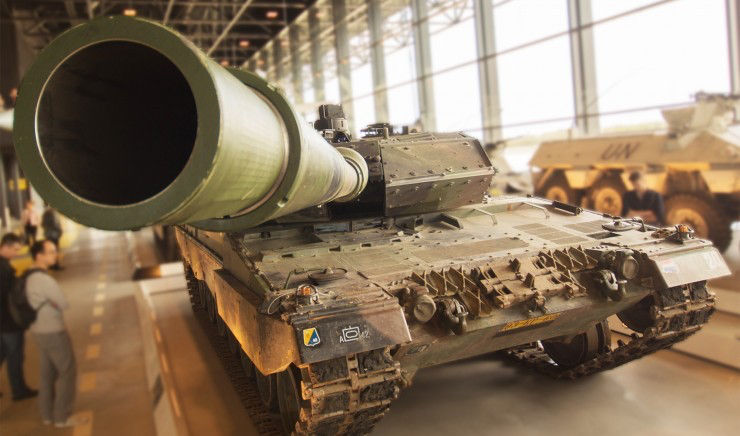
The post-war era saw the evolutionary arms race continue, leading to the development of the Main Battle Tank (MBT)—a single, powerful breed designed to combine the mobility of a medium tank with the firepower and protection of a heavy. The lineage of British MBTs is particularly well-represented, beginning with the highly successful Centurion, one of the most advanced and widely exported designs of its time, and its successor, the formidable Chieftain.
The current alpha of this line is the Challenger 2, the serving MBT of the British Army. Weighing in at 64 tonnes and protected by advanced Chobham armour, its 120mm rifled gun and top road speed of 37 mph represent the pinnacle of this particular evolutionary path. The museum’s archives even hold the declassified documents that detail the decision-making process behind its selection to replace the Chieftain, offering a unique glimpse into the creature’s developmental history.
The Great Gatherings – Observing Seasonal Behaviour
The Bovington reserve is not a static collection; it is a dynamic environment marked by spectacular seasonal events. These gatherings are a symbiotic fusion of historical commemoration and modern entertainment, where the “animals” are put through their paces, recreating the behaviours and struggles of their natural history for a modern audience. This approach, blending education with high-octane spectacle, secures a diverse audience and ensures the museum’s financial health, allowing it to continue its core mission of preservation.

The Thunder in the Arena – TANKFEST
TANKFEST can be likened to a great annual migration, drawing some 24,000 enthusiasts from across the globe for what is billed as “the world’s biggest and best live display of historic moving armour”. For three days in June, the air is filled with the roar of engines and the smell of diesel as dozens of tanks shake the ground of the Kuwait Arena. The event features explosive battle re-enactments, living history encampments, and guest vehicles from the modern British Army. Its global significance was cemented in 2025, when the event hosted the world’s only running Tiger I and King Tiger tanks together for the first time in 80 years—a truly once-in-a-lifetime sighting.
The Roar of the Tiger – The Tiger Day Ritual
If TANKFEST is a great migration, Tiger Day is a more focused, semi-annual pilgrimage for devotees of the apex predator. Held each April and September, these are the only two days a year that the legendary Tiger 131 is put on public display in motion. The event is a sell-out attraction, attracting 4,500 people for each running. The day’s programme features a supporting cast of other Second World War vehicles, including the Panzer III, Sherman, and Churchill, culminating in a climactic battle re-enactment of Tiger 131’s capture in Tunisia. For a small fee, visitors can even enter a raffle to win a ride inside the Tiger itself—a unique opportunity to join the crew and become part of the legend.

The Expedition Planner – A Guide for the Intrepid Naturalist
Mounting Your Expedition from Bournemouth
For the prospective naturalist, the coastal town of Bournemouth serves as an excellent base camp for an expedition to the Bovington reserve. However, the final leg of the journey requires careful planning. The key logistical hurdle for those relying on public transport is the “last mile”—the 1.5-mile (2.4 km) distance from the nearest railway station, Wool, to the museum itself. Several migration routes are available, each with distinct advantages.
| Mode of Transport | Estimated Journey Time | Estimated Cost (One-Way) | Key Considerations & Supporting Snippets |
| Car | 35-45 minutes | £5-£8 (fuel) | The most direct and flexible option. Clearly signposted with brown tourist signs. Ample free on-site parking for cars and coaches. |
| Train & Taxi | 40-50 minutes total (Train: ~30 mins; Taxi: 5-7 mins) | £7.60+ (train) + £9-£13 (taxi) | A fast and convenient option that avoids the walk. Taxis are available at Wool station, but pre-booking a return journey is highly recommended, especially on non-event days. |
| Train & Bus | 50-60 minutes total (Train: ~30 mins; Bus: 8-10 mins) | £7.60+ (train) + ~£2 (bus) | A cost-effective choice, but requires careful planning. Bus services (e.g., the X50 Jurassic Coaster) are often seasonal (summer). Always check the latest timetable online before travelling. |
| Train & Walk | 1 hour 5 mins – 1 hour 15 mins total (Train: ~30 mins; Walk: 30-40 mins) | £7.60+ (train) | The most economical option for the able-bodied. A safe, well-signposted, and wheelchair-friendly footpath leads directly from Wool station to the museum. |

Park Entry & Provisions (Tickets, Timings, and Sustenance)
The reserve is open daily from 10am to 5pm, though it is closed on select dates in November and over Christmas. It is highly advisable to book tickets online in advance, as this offers a 15% saving compared to the on-the-door price. A standard adult online ticket costs around £19.55, with concessions available for children and families. One of the most significant benefits is that every full-price admission ticket automatically includes a free Annual Pass, allowing for unlimited return visits for a year (excluding special event days like TANKFEST and Tiger Day). Given the scale of the collection, this represents exceptional value. For sustenance during a long day’s expedition, an on-site restaurant and café offer a range of meals and snacks.
Field Notes for the Observer
To do the vast collection justice, visitors should allow a minimum of four to five hours for their visit. For those on a tighter schedule, the museum recommends focusing on the “Tank Story” exhibition for a chronological overview. The reserve is remarkably family-friendly, with numerous interactive exhibits, a soft play area, and knowledgeable staff making it an engaging safari for all ages. No expedition is complete without a visit to the extensive gift shop, a popular final stop where observers can acquire models, books, and other memorabilia of the fascinating species they have encountered.

A Living History, A Roaring Conservation
A journey to Bovington is an encounter with more than just machinery. While it is a sanctuary for some of the most powerful vehicles ever built, it is, more importantly, a vessel for human stories and a place of solemn remembrance. This is most powerfully embodied in the Memorial Room, which commemorates the sacrifice of almost 13,000 Royal Armoured Corps soldiers who have died in service since 1939.
This is not a silent, dusty collection of relics. It is a living, breathing, and roaring institution. The sound of Tiger 131’s engine echoing across the Dorset hills is not merely a mechanical noise; it is the sound of history being actively preserved and shared with a new generation. A visit is an unforgettable encounter with the iron giants that shaped the 20th century—creatures that, thanks to the dedicated wardens of Bovington, can still be witnessed in all their thundering glory.

Leave a Reply
You must be logged in to post a comment.