

Stepping onto the Jurassic Coast: A First Glimpse of the Mighty Arch
There is a moment, as you follow the well-trodden path from the cliff-top car park, when it happens. The rolling green of the Dorset hills gives way, the path crests a rise, and the view opens up into a breathtaking panorama. Before you, the English Channel stretches out, a vast expanse of shimmering blue and silver. To your left and right, brilliant white chalk cliffs plunge dramatically into the sea. And there, standing sentinel against the ceaseless roll of the waves, is Durdle Door.
It is one of the most recognisable and photographed landmarks in the United Kingdom, a perfect limestone arch that has become the enduring symbol of the Jurassic Coast, a UNESCO World Heritage Site. Yet, a photograph can only capture a fraction of its majesty. To truly experience it is to feel the salt-laced wind on your face, to hear the cry of gulls circling overhead, and to listen to the rhythmic percussion of waves crashing onto the shingle beach far below. This is more than just a destination; it is a journey back through deep time, a place where the immense, slow power of the Earth is laid bare for all to see. The anticipation built during the walk is rewarded with a vista that feels both ancient and profoundly alive.

The Earth’s Masterpiece: A 140-Million-Year Story
To understand Durdle Door is to read a story written in stone, a dramatic narrative of tropical seas, continental collisions, and the patient artistry of erosion. Its origins lie around 140 million years ago, during the late Jurassic and Cretaceous periods, when this part of Dorset was a warm, shallow sea. Over millennia, layers of sediment—the remains of countless marine organisms, shells, sand, and clay—settled on the seabed, hardening into distinct horizontal bands of rock.
For nearly 100 million years, these layers lay flat. Then came the cataclysm. Around 25 to 50 million years ago, the African tectonic plate began a colossal, slow-motion collision with the European plate. The same immense pressures that crumpled the Earth’s crust to create the Alps sent geological ripples northwards through Europe. Here in Dorset, these forces buckled and folded the once-horizontal rock strata, heaving them into a near-vertical position. This spectacular fold, known as the Lulworth Crumple or the Purbeck Monocline, is the crucial event that set the stage for the arch’s creation.

This tectonic upheaval created what geologists call a concordant coastline, where the now-vertical bands of rock run parallel to the shore. The key to this landscape’s unique formation lies in the specific sequence of these bands. A wall of hard, resistant Portland Limestone (around 150 million years old) faced the sea, acting as a natural sea defence for the much softer layers of Wealden clays and sands behind it. Further inland lies a much thicker, stronger band of chalk, which forms the rolling Purbeck Hills.
The sea, a relentless sculptor, began its work. Pounding the limestone barrier for thousands of years with the force of hydraulic action and the abrasive power of sand and shingle, it eventually exploited a weakness, punching a hole through the rock. Once breached, the waves could attack the soft, vulnerable clays and sands behind the limestone wall, rapidly scouring them out to form a small bay. The magnificent arch of Durdle Door is what remains of that original limestone barrier—a triumphant survivor of the sea’s assault. The name itself, derived from the Old English word ‘thirl’, meaning to pierce or drill, is a testament to how our ancestors understood this process over a thousand years ago.
Durdle Door is not an isolated marvel but part of a wider family of geological features telling the same story. To the west, a line of small rocky islets—The Bull, The Blind Cow, The Cow, and The Calf—are the last remnants of the same limestone band, showing the coastline in a more advanced state of erosion. To the east, the rocks of Man O’ War Bay show the barrier still largely intact. Nearby Lulworth Cove is a sibling landmark, formed by the very same process but on a grander scale, where a wider breach allowed the sea to hollow out a near-perfect circular cove, its entrance still guarded by the remnants of the Portland limestone.

Myths, Movie Stars, and a Dragon Drinking from the Sea
Long before geologists decoded its history, Durdle Door captured the human imagination, inspiring stories to explain its otherworldly form. These layers of folklore and culture are as much a part of the landmark as the rock itself. One local legend claims the Devil, in a fit of pique, punched a hole through the rock, leaving his mark on the coast. Another tale speaks of a mermaid who, heartbroken over a mortal fisherman, struck the cliff and created a window to the sea. There are even whispers of the lost, sunken city of Manweller, said to rise from the depths on certain nights, and of pirate treasure buried in a nearby cave.

This timeless, dramatic beauty has not been lost on modern storytellers. Durdle Door’s striking form has made it a coveted filming location, cementing its status as a globally recognised icon. It has provided a backdrop for major films, including the fantasy adventure Nanny McPhee (2005), the historical drama Far from the Madding Crowd (2015), and the biographical film Wilde (1997). Each appearance on screen has broadcast its unique silhouette to a new audience, reinforcing its place in popular culture.
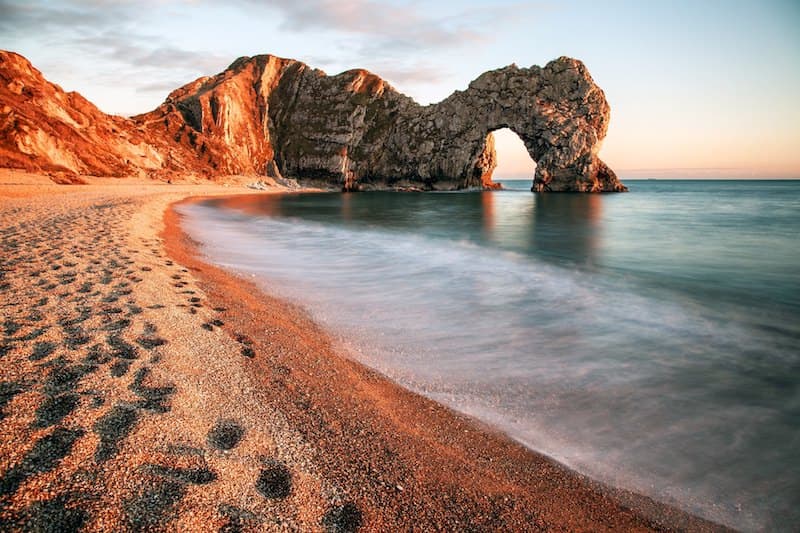
For photographers, the arch offers an almost endless source of inspiration. One of the most popular interpretations, especially when viewed from the beach, is that it resembles a great prehistoric creature—a dinosaur or dragon—stooping to drink from the sea. This evocative image perfectly connects the landmark back to its Jurassic Coast identity, bridging the gap between scientific fact and artistic imagination.

The Complete Durdle Door Planner: Your Essential Guide
A visit to a wild and popular location like Durdle Door is most rewarding with a bit of planning. The entire site, including the car parks, is managed by the Lulworth Estate, which works to balance public access with the conservation of this fragile environment. Understanding the logistics is key to a smooth and enjoyable day.
Your Journey to the Coast
Getting to Durdle Door can be straightforward, but the best method depends on your priorities: time, cost, or convenience.
| Travel Method | From Bournemouth (Approx. Time) | Key Considerations |
| By Car | 35-45 minutes | Fastest and most flexible. Allows you to set your own schedule. Parking is expensive and can fill up completely on peak days, requiring an early start. |
| Train & Bus | 1 hour 15 minutes – 1 hour 30 minutes | Environmentally friendly and avoids parking stress. You are tied to train and bus timetables, which can be infrequent, especially off-season. |
| Direct Bus Tour | 2.5 hours (includes scenic route) | Easiest public transport option with no transfers. Less flexible with fixed departure/return times. Good for a day trip from London via train connection. |

- By Car: This is the fastest option. From Bournemouth, the drive is roughly 23 miles and takes around 35 minutes. Set your satnav for the Durdle Door car park, postcode BH20 5PU. Key roads include the A352 and B3070.
- By Public Transport: The most common route involves taking a South Western Railway train from Bournemouth to Wool station. From Wool, you can catch a bus to the Durdle Door Park Entrance. Services include the year-round X54 and the seasonal Jurassic Breezer buses (routes 30 and 31), but be sure to check timetables in advance as services can be infrequent, especially outside of the summer months.
- By Direct Bus Tour: For a hassle-free day trip, several companies run direct bus tours from Bournemouth. These often include a scenic drive through Sandbanks and Poole Harbour, dropping you at Durdle Door and picking you up from Lulworth Cove later in the day.

Parking Decoded: Navigating the Lulworth Estate
The official car parks are the most convenient way to access the site. The system is designed to manage the high volume of visitors and fund the area’s upkeep.
- Official Car Parks: There are three main car parks managed by the Lulworth Estate: Durdle Door car park (closest), Newlands Meadow (an overflow field used on busy days), and Lulworth Cove car park (a mile’s walk away).
- Costs & Payment: Parking is not cheap, reflecting the cost of maintaining a world-class natural attraction. Current prices for cars are approximately £12.40 for up to 4 hours and £20 for a full day. The car parks use an ANPR (Automatic Number Plate Recognition) system; you pay at a machine before you leave by entering your registration number. Payment can be made by card, Apple Pay, or Google Pay. A significant benefit is that a ticket purchased at Durdle Door is also valid at the Lulworth Cove and Lulworth Castle car parks on the same day, allowing you to explore the whole area.
- Opening Times: The Durdle Door car park has seasonal hours. From March to October, it is typically open from 8am to 9pm. From November to February, it closes earlier, around 5pm. It is crucial to note that the gates are locked at closing time and no overnight sleeping is permitted.
- The “Free” Parking Dilemma: There are very limited free parking alternatives. A small layby at Dagger’s Gate, just before the main car park entrance, has space for about five or six cars. Some on-road parking can be found in the villages of West Lulworth or Wool, but this requires a much longer walk or a bus journey to reach Durdle Door. If you attempt this, be mindful of residents and ensure you do not block access, as this has been a problem for emergency vehicles in the past.
The Descent to the Beach: What to Expect and What to Pack
The journey from the car park to the beach is an integral part of the experience and requires preparation.
- The Path: From the car park, it is a steep 15 to 20-minute walk down a gravel path to the cliff edge overlooking the beach. From there, a final flight of around 90 steep steps leads down to the shingle.
- Accessibility: Due to the steep, uneven path and the final flight of steps, the beach is not accessible for wheelchairs, pushchairs, or visitors with significant mobility impairments.
- Facilities: Be prepared for a wild beach experience. All facilities—toilets, refreshment kiosks, and souvenir shops—are located up at the car park level. There are no toilets, shops, or rubbish bins on the beach itself.
- Essential Packing List: Given the lack of facilities and the strenuous walk, pack wisely.
- Sturdy Footwear: Trainers or walking shoes are essential. Do not attempt the walk in flip-flops or heels.
- Supplies: Bring plenty of water and snacks for your time on the beach.
- Sun Protection: There is very little shade on the beach, so sunscreen, hats, and cover-ups are vital, even on cloudy days.
- A Rubbish Bag: You must carry all your litter back up the hill with you. “Leave only footprints” is the guiding principle here.

Adventures Beyond the Arch: Making the Most of Your Visit
Once you’ve made the descent, a range of unforgettable experiences awaits. Whether you’re a hiker, a photographer, or a wild swimmer, Durdle Door offers a unique adventure.
The Unmissable Coastal Walk: Durdle Door to Lulworth Cove
One of the finest short coastal walks in England connects Durdle Door with its geological sibling, Lulworth Cove.
- The Route: The walk follows the South West Coast Path. It is a linear route of approximately one mile each way, taking about 30 minutes in one direction, though you should allow much more time for stopping to admire the spectacular views. The path involves a very steep climb from Lulworth Cove up the hill known as Hambury Tout, followed by a walk along the cliff top before descending towards Durdle Door.
- Difficulty: The walk is easy to navigate but can be physically demanding. The initial climb involves an elevation gain of over 130 metres, making it a moderately strenuous effort.
- Circular Options: For keen hikers, longer circular routes are possible. A popular 5-mile (8.2km) circuit returns from Durdle Door via the beautiful dry valley of Scratchy Bottom and inland paths, offering a different perspective on the landscape.
- Practicalities: Dogs are welcome on the beaches at Durdle Door and Lulworth Cove, as well as on the coastal path, throughout the year.
A Photographer’s Paradise: How to Capture the Perfect Shot
Durdle Door is a world-class photography location. To get the best shots, it pays to know the key vantage points and the best times to visit.
- Key Vantage Points:
- The Classic Cliff-Top View: The most famous shot is from the top of the path, just before the steps, looking down towards the arch. The curving path and steps create a perfect leading line into the frame.
- The Beach Perspective: Walk down onto the shingle and along the beach. From a low angle, the arch appears to be a “dinosaur drinking from the sea,” with the curve of the shoreline leading the eye towards it.
- The Man O’ War Bay Overlook: From the classic cliff-top viewpoint, simply turn around. The view east captures the perfect semi-circular sweep of Man O’ War Bay. The water here often has a stunning turquoise hue, caused by light reflecting off chalk sediment eroded from the cliffs.
- Best Times to Shoot:
- Sunrise: The ultimate shot for many landscape photographers. In the heart of winter (early December and early January), the sun rises directly through the arch, offering the chance for a dramatic “sunstar” image and ethereal beams of light if there is sea mist.
- Sunset: During autumn and winter, the setting sun is in a position to cast a beautiful golden light across the face of the arch.
- Night: For astrophotographers, the core of the Milky Way is visible above the arch in the dark skies between late March and July.
Taking the Plunge: A Guide to Swimming at Durdle Door
Swimming in the clear waters beneath the great arch is an exhilarating and unforgettable experience. However, it comes with significant risks that must be understood and respected.
- The Experience: The water at Durdle Door and the adjacent Man O’ War Bay is often crystal clear and aquamarine, making it incredibly inviting. Man O’ War Bay, being more sheltered, is often a calmer option for paddling and gentle swimming.
- Safety and Risks: This is a wild swimming location. There are no lifeguards on duty at any time. The primary dangers are:
- Steeply Shelving Seabed: The seafloor drops away very quickly. You can be out of your depth just a few steps from the shore.
- Currents: The area can be subject to strong currents and rip tides.
- Cold Water: Even in summer, the English Channel is cold and can induce shock.
- Official Advice: Swim with extreme caution, know your limits, and never swim alone. Children must be supervised closely at all times. Always check the tide times and weather forecast before entering the water. For those seeking a safer experience, licensed operators offer guided wild swimming adventures at the site.
Preserving a Natural Wonder
Durdle Door is not a permanent fixture. It is the product of an ongoing battle between rock and sea, part of a dynamic, constantly eroding landscape. A major landslide just east of the arch in 2013 was a stark reminder of how fragile this coastline is. As visitors, we are temporary custodians of this magnificent feature within a UNESCO World Heritage Site.
The management efforts of the Lulworth Estate and the Jurassic Coast Trust are vital, but every visitor has a role to play in its preservation. By sticking to the designated paths, you help prevent erosion that can scar the landscape and destabilise the cliffs. And by taking every single piece of your rubbish back up the hill with you, you ensure that this awe-inspiring view remains unspoilt for the next person, and for generations to come. Leave only footprints and take away memories of one of the planet’s truly great natural masterpieces.
Leave a Reply
You must be logged in to post a comment.